
Turn Enemy into Friend: Allow Distraction to Help Your Meditation Go Deeper

Many people postpone meditation or struggle to practice consistently because they feel they don’t have the “right,” distraction-free environment.
They believe they need a perfectly quiet room to meditate, something like a calm retreat in the mountains—no kids, no street noise, no interruptions, just pure peace.
They keep telling themselves they will start once the kids grow up, when they can finally go on a retreat, or when their mind becomes quiet. But the idea that distraction is the enemy of meditation is just another myth.
Distraction isn’t your enemy. It can be your training partner in resistance training. Adopting this lens is incredibly helpful for modern people who live in a fast-paced, demanding world.
When approached correctly, distraction strengthens the very meditation skills you are trying to build.
The Kitchen Noise That Helped My Meditation Go Deeper
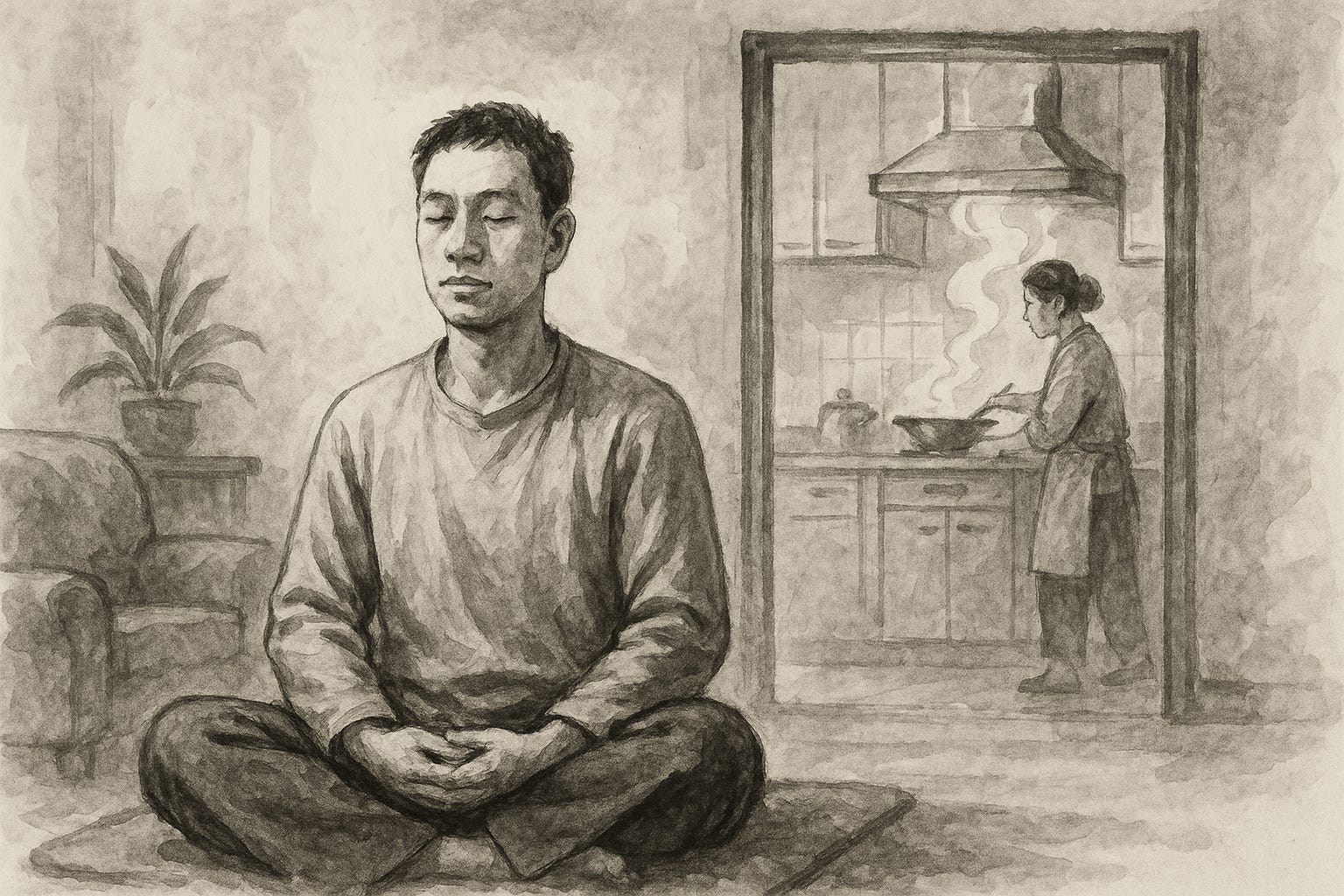
A few weeks ago, I stayed at my parents’ home. As usual, I started meditation around 6:00 a.m. Around 6:30, my mom came downstairs and began her morning routine—cooking breakfast, washing dishes, opening and closing cabinets.
Then the range hood came on, and its noise was earth shaking.
Ironically, my focus object that week was the restful quality in my body. But with every slam of the cutting board and every blast of the hood, my attention was pulled away.
Every time it happened, I brought my attention back—not once or twice, but dozens of times. During that period it didn’t feel deep at all. It felt like a tug-of-war between rest and chaos.
Later, my mom stepped outside, the range hood turned off, and the living room where I sat became completely quiet.
Suddenly, my meditation dropped into a very different state, one of wide, quiet spaciousness where the boundary between “inside” and “outside” felt thinner. A clarity I had not experienced earlier emerged.
Why?
Distraction Is Part of the Practice
Meditation always involves some kind of focus object: the breath, body sensations, a sound, or spacious awareness. Once you choose a focus object, everything else becomes a distraction by default.
Unless you are practicing open-awareness meditation or its variations, distraction naturally appears. In those styles, everything counts, so distraction doesn’t exist—and you won’t mind anything, because the technique itself does not exclude anything.
In most meditation traditions, the relationship between focus object and distraction is like the sun and its shadow—one brings the other. If you think about it, if there were no distractions at all, how would you know you’re meditating? Without distraction, there is nothing to return from, no reference point, and no way to train the mind.
It is like trying to build muscle without resistance. You simply can’t.
In fact, the moment you notice your attention has wandered is the moment mindfulness training is happening.
Distraction Strengthens All Three Skills of Mindfulness
In Unified Mindfulness, mindfulness consists of three attention skills: concentration, sensory clarity, and equanimity. These are like three groups of muscles you can train.
Distraction plays the role of an unpredictable training partner who suddenly adds extra weight to your bench press. You can either give up or try to lift it. If you try to lift it—even imperfectly—the muscles grow.
The first skill is concentration, the ability to direct your attention toward what you deem important. Every time I returned from the noise to the restful quality of my body, it was like performing one more rep. Yes, it was hard—the pulling force of the noise plus the subtle annoyance were strong. My return to the restful feeling wasn’t perfect, but concentration increased every time I completed that rep.
The second skill is sensory clarity, the ability to track experience in real time with precision. To stay with the restful quality, I needed to separate it from the noise, my inner commentary, the slight annoyance it triggered, the ache in my legs, and everything else. By this filtering processes in the background of my mind, clarity sharpened.
The third skill is equanimity, the ability to allow experiences to be as they are without pushing or pulling. Since the noise and the inner reactions didn’t stop, I had to let them be. This included not only the external sound but also the internal responses. By continually allowing them, equanimity deepened.
So here is why I dropped into a deep state after the kitchen noise disappeared
After that period of intense “resistance training” triggered by the kitchen noise, my mindfulness skills were temporarily strengthened: concentration, clarity, and equanimity were all high.
So when the house suddenly became quiet, with high skills and low external challenge, I dropped into a deep meditative state almost instantly. It’s like bench-pressing 200 pounds and then suddenly switching to 100 pounds. The lighter weight feels effortless.
Outer Noise and Inner Chaos: The Orange Belt and Black Belt Masters
In addition to viewing distraction as a resistance-training partner, we can also see it as a set of sparring partners in martial arts. External distractions such as noise, people, pets, or traffic are like “orange belt” sparring partners. They challenge you, but they are not very intense.
The real challenge is internal distraction, the stronger “black belt” partner. This includes painful memories, worries, fantasies, self-judgment, regret, imagined conversations, and endless mental to-do lists.
These are more difficult because we identify with them. We treat them as “mine”—my thoughts, my ideas, my feelings.
But during meditation, thoughts and emotions appear only as mental images or mental talk, nothing more. They are no different from a TV advertisement or street noise. For the latter, you see and hear out; for the former, you see and hear in.
They are both simply seeing and hearing. They are not that different. The key is to treat internal distraction the same way you treat external distraction. Let them arise and pass.
Distraction is like a tornado swirling around you while you sit in the calm eye of the storm. Everything moves, but the real you remains untouched. Appreciate the tornado-like “black belt” sparring partners. They help you grow faster.
Another way to work with the black-belt partners is to use meditation techniques whose focus range includes inner reactions—mental images and mental talk. For example, Unified Mindfulness’ signature technique See Hear Feel does exactly this. (If you are interested in learning this technique, DM me and I can send you some learning material.)
You’re Not Failing. You Are Training Intensely
Distraction is not a sign of failure. It is a sign that you are training.
Every time you notice that you drifted, recognize where you drifted to, and gently return without judgment, you are polishing your three attention skills.
When the three attention skills improve, your mindfulness improves, and your baseline happiness improves with it. You become less reactive, more awake, and more skillful in how you act in the world.
So the next time your neighbor drills the wall, your child screams, your cat meows, or your mind replays an old wound, don’t fight it.
Smile. You’ve just met your training/ sparring partner in disguise.
Now I want to hear from you
What do you think about distraction in meditation? How do you handle it? Is there anything interesting you want to discuss?
I liked your piece today, Muse !
I use a similar process t when I got stroken by a repulsion ...
that turns into procrastination ...
My favorites distraction is when a deep repulsion hits.. and put me in a freeze -like state...
then I use curiosity to stay close, instead of fleeing..
then my systems learns, and it goes off my DMN... Finally ...